How to Get More Patients for an Aesthetic Clinic in Dubai
Aesthetic clinic marketing in Dubai: DHA advertising rules, Google and Meta limits on injectables, procedure pages and WhatsApp follow-up to consultation.
On this page
- The short version
- Who can practise aesthetics in Dubai
- DHA’s advertising rules for clinics, in plain words
- Google Ads for aesthetic clinics: what the policies allow
- Facebook and Instagram ads: Meta’s rules for cosmetic procedures
- Procedure pages that answer before they sell
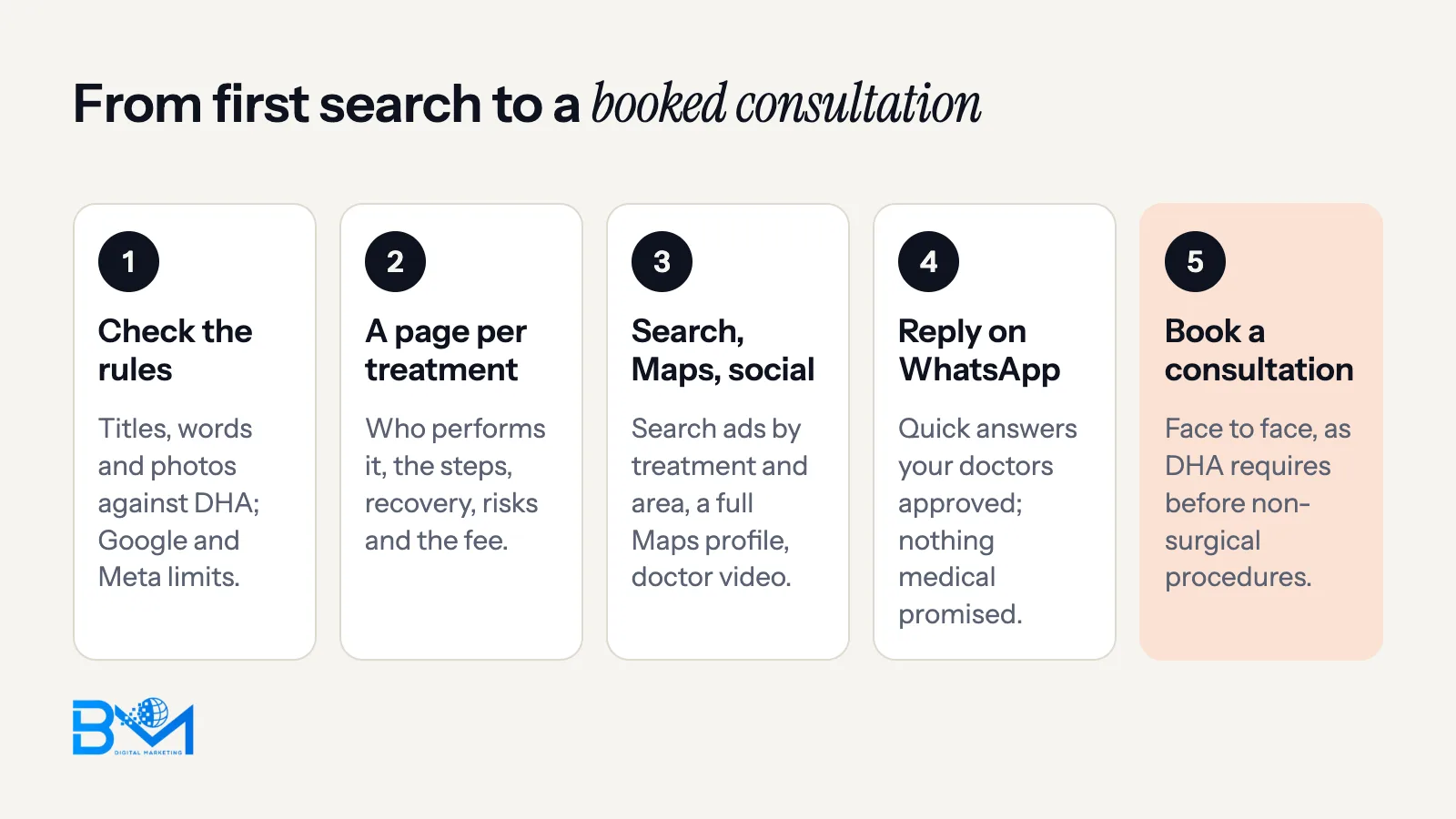
- From first message to booked consultation
- How to measure what your marketing brings
- How we approach aesthetic clinic marketing at BM
- Frequently asked questions
- Want it done for you?
- Sources
An aesthetic clinic in Dubai gets more patients by being found for the exact treatment a patient is researching, answering their questions quickly and carefully, and turning that conversation into a face-to-face consultation. Every one of those steps has rules: the Dubai Health Authority (DHA) decides what clinic advertising may say, and Google and Meta set their own limits on injectables, cosmetic procedures and audience targeting.
This guide covers the rules to check before any advert runs, then the pages, campaigns and follow-up that turn searches into booked consultations. Every rule comes from DHA’s published standards or from Google’s and Meta’s own policy pages, checked in November 2026; the sources are listed at the end.
The short version
- Titles and words: use the exact title on each practitioner’s DHA licence. DHA rules out words such as “the best”, “100%”, “no side effects” and “immediate results”.
- Photos: before-and-after images need written consent, the same person and lens, no editing, and DHA’s statement that results vary.
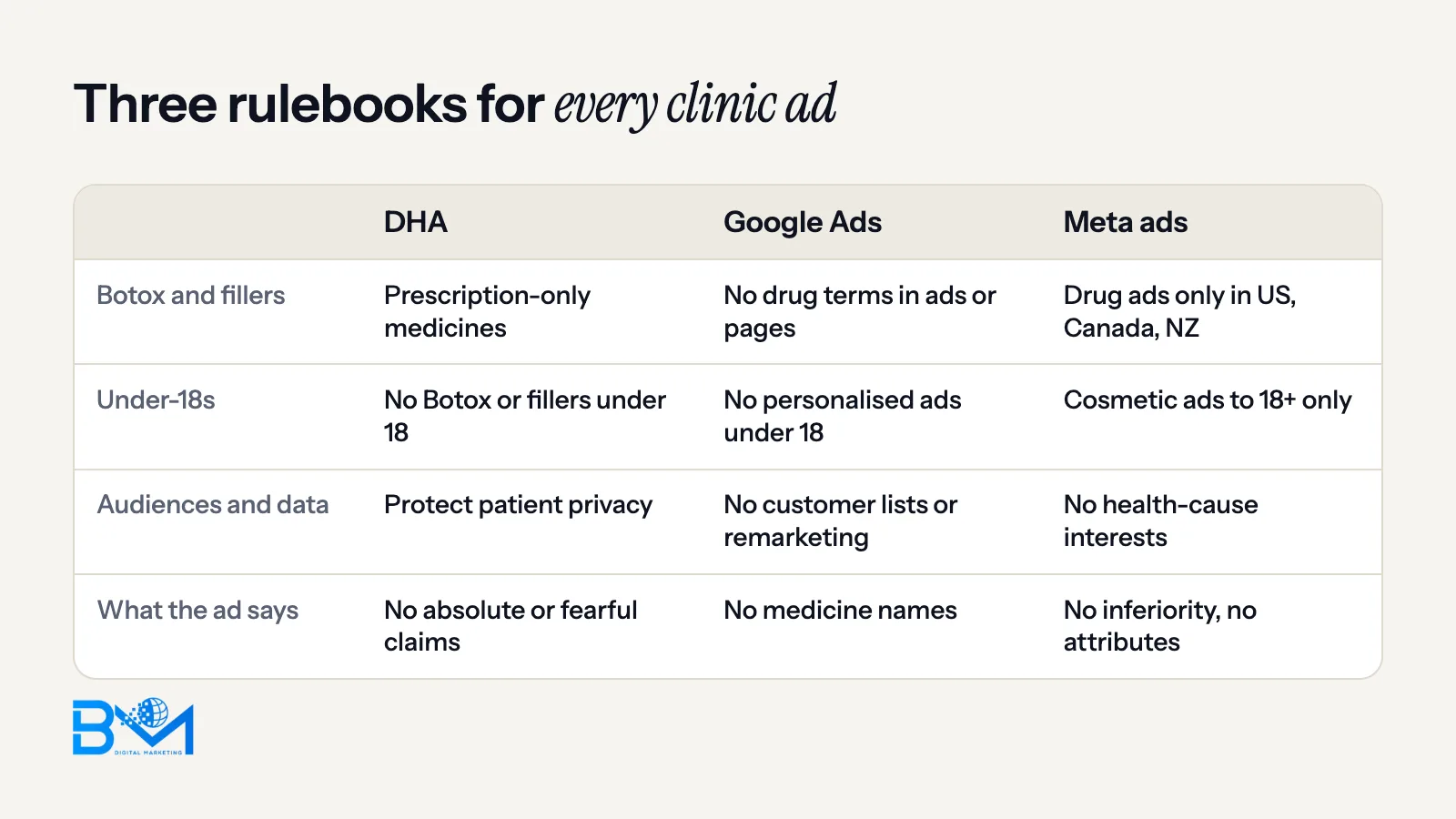
- Injectables: DHA classes cosmetic Botox and fillers as prescription-only medicines, and Google does not allow prescription drug terms in UAE ads or landing pages. Advertise the consultation, not the medicine.
- Meta: cosmetic procedure ads must target people aged 18 or over and must not imply anything about the viewer’s appearance or health.
- Google audiences: cosmetic surgery and injections sit in Google’s sensitive health category, so customer lists and remarketing can’t be used for those ads.
- The goal: DHA makes a face-to-face consultation mandatory before any non-surgical cosmetic procedure. Count booked consultations, not clicks.
Who can practise aesthetics in Dubai
Aesthetic treatments in Dubai are health services, given in DHA-licensed facilities by DHA-licensed professionals under DHA’s Standards for Non-Surgical Cosmetic Procedures. Three rules in that standard shape your marketing:
- Injectables are for doctors. Cosmetic Botox and fillers are classified as prescription-only medicines and may only be given by a trained and privileged licensed physician. They are not permitted for patients under 18.
- A specialist supervises. The facility must have at least one DHA-licensed consultant or specialist plastic surgeon or dermatologist, full or part time, to supervise non-surgical cosmetic procedures.
- Other staff work from a limited list. Registered nurses, physiotherapists, massage therapists and beauty therapists may provide only a limited number of non-surgical cosmetic procedures, under the conditions the standard sets.
So the person who fronts an advert must be allowed to do what it promotes, and titles must match the licence. DHA’s social media standard tells staff not to use titles that differ from their DHA licence, naming examples such as “Aesthetic Specialist”, “Aesthetician” and “Cosmetologist”. The prefix “Dr.” is reserved for physicians, dentists and other professionals holding a recognised PhD.
Which regulator applies to your clinic
DHA’s standard names the health authorities by geographical jurisdiction: the Ministry of Health and Prevention (MOHAP), the Department of Health in Abu Dhabi, the Dubai Healthcare City Regulatory Authority and DHA. A clinic in Dubai Healthcare City or another emirate follows its own regulator. Standards are revised, so check the current version before acting.
DHA’s advertising rules for clinics, in plain words
DHA’s Standards for Medical Advertisement Content on Social Media apply to all DHA-licensed health facilities and healthcare professionals that advertise on social media. Its definition of social media includes Facebook, Instagram, WhatsApp, YouTube, Snapchat and LinkedIn, and is not limited to them. Write every advert, landing page and post to these rules.
Words DHA rules out
The standard bans absolute statements, exaggerated claims and alarming expressions. Its list includes “unique”, “the best”, “exclusive”, “safest”, “the only”, “incomparable”, “unprecedented”, “magic”, “miraculous”, “assured success”, “has no side effects”, “get money back”, “100%”, “pioneer” and “immediate results”. Its appendix also flags phrases such as “achieve the look you want” and “looking better and feeling more confident” for creating unrealistic expectations. Words that cause fear, anxiety or distress are prohibited, and any claim about a treatment’s outcome must be substantiated and include the associated risks.
What you can say
The same appendix lists what is acceptable: a factual and clear statement of your services, contact details and office hours, the languages your practitioners speak, qualifications and titles as recognised by DHA, accreditations, and a statement about fees and instalment plans.
| You might write | The problem under DHA’s standard | Write this instead |
|---|---|---|
| “The best aesthetic clinic in Dubai” | “The best” and “the only” are on the banned list | “Dermatology and aesthetic treatments in Jumeirah”, with your real area |
| “No side effects, immediate results” | Both are banned, and outcome claims must state the risks | What the treatment involves, the usual recovery and the risks |
| “Our aesthetic specialist” or “cosmetologist” | Titles must match the DHA licence | The practitioner’s name and the exact title on their licence |
| “Don’t delay, achieve the look you want” | Flagged for creating unrealistic expectations | “Book a consultation to see whether this treatment suits you” |
| “Free trial session” | Trial usage of medical products or services is prohibited | A clear price, with its conditions |
| The DHA logo on your post | DHA’s name or logo needs explicit written approval | Your clinic name and your own branding |
Before-and-after photos
DHA allows them on strict terms. The photos must show the same person, taken with the same lens, with no Photoshop or similar editing. They must state the risks and carry the sentence “there is no guarantee that the result will be the same, as it might vary from one individual to another”, in the same font size as the rest of the advert. You need the patient’s written, documented consent, valid only for the period it was given for. Filming or live-streaming a patient during surgery under general anaesthesia, or in procedure rooms, to promote the clinic is not allowed.
Influencers, doctors’ accounts and your licence number
- When a doctor, influencer or staff member promotes a service naming your clinic or its location, the clinic’s Medical Director must approve the content.
- Doctors must use separate personal and professional accounts.
- Your clinic’s official account must state its medical advertisement licence number issued by MOHAP.
- Social media content may not use the DHA name or logo, or any other government body’s, without explicit written approval.
- Patient testimonials need written consent, and patient privacy must be protected at all times.
Google Ads for aesthetic clinics: what the policies allow
Two Google policies matter more for clinics than any bidding setting.
No medicine names in ads or landing pages
Google’s restricted drug terms policy says campaigns targeting locations other than Canada, New Zealand and the United States may not use prescription drug terms in ads or landing pages. Google’s list of the prescription drugs it monitors includes “botox” and “botulinum toxin”. Write your Google ads, and the pages they lead to, around the treatment and the consultation with your doctor, and check Google’s list before using any product or brand name.
No customer lists or remarketing for injections and surgery
Google treats health as a sensitive interest category, and its definition includes “invasive medical procedures, including cosmetic surgery, surgical procedures, or injections”. Advertisers promoting anything in a sensitive category cannot use advertiser-curated audiences: Customer Match, your data segments (previously called remarketing), audience expansion and lookalike segments. Google’s predefined audiences are still allowed, and people under 18 are not eligible for personalised ads at all. So a filler or rhinoplasty campaign is built on what people search, where they are and when your team can answer, not on a list of past patients.
Structure the account by treatment family (skin, injectables, surgery, hair, lasers), target the areas around each branch in English and Arabic, schedule ads for the hours your coordinators reply, and record booked consultations as their own conversion. Our guide to getting more leads from Google Ads in Dubai covers the set-up.
Facebook and Instagram ads: Meta’s rules for cosmetic procedures
Meta’s advertising standards allow cosmetic procedure ads on Facebook and Instagram, with conditions:
- 18 and over only. Ads promoting cosmetic products, procedures or surgeries must be targeted to people at least 18 years old. Meta’s list includes dermal fillers, injectable treatments, chemical peels, micro-needling, laser treatments, rhinoplasty and hair restoration surgery.
- Before-and-after is allowed for general cosmetic procedures. DHA’s conditions still apply on top.
- No statements of inferiority that attack a person’s appearance, body parts or hygiene.
- No personal attributes. Ads must not assert or imply anything about the viewer’s health or age. Meta’s own example of a line that breaks this rule is “Ready to upgrade your skin to look younger?”
- No prescription drug ads. Meta allows prescription drug promotion only from certified advertisers targeting the United States, Canada or New Zealand.
Every ad has to pass both rulebooks. Meta’s personal attributes page accepts a line about creams that “fight wrinkles like never before”. Under DHA’s standard, that sits close to “unprecedented” and “incomparable”, which are banned. Write to the stricter of the two.
In January 2022 Meta removed detailed targeting options relating to health causes, so campaigns reach people by area, age, language and the creative itself. Lead forms and click-to-WhatsApp ads both suit consultations. Our article on how social media marketing brings in customers covers the organic side.
Procedure pages that answer before they sell
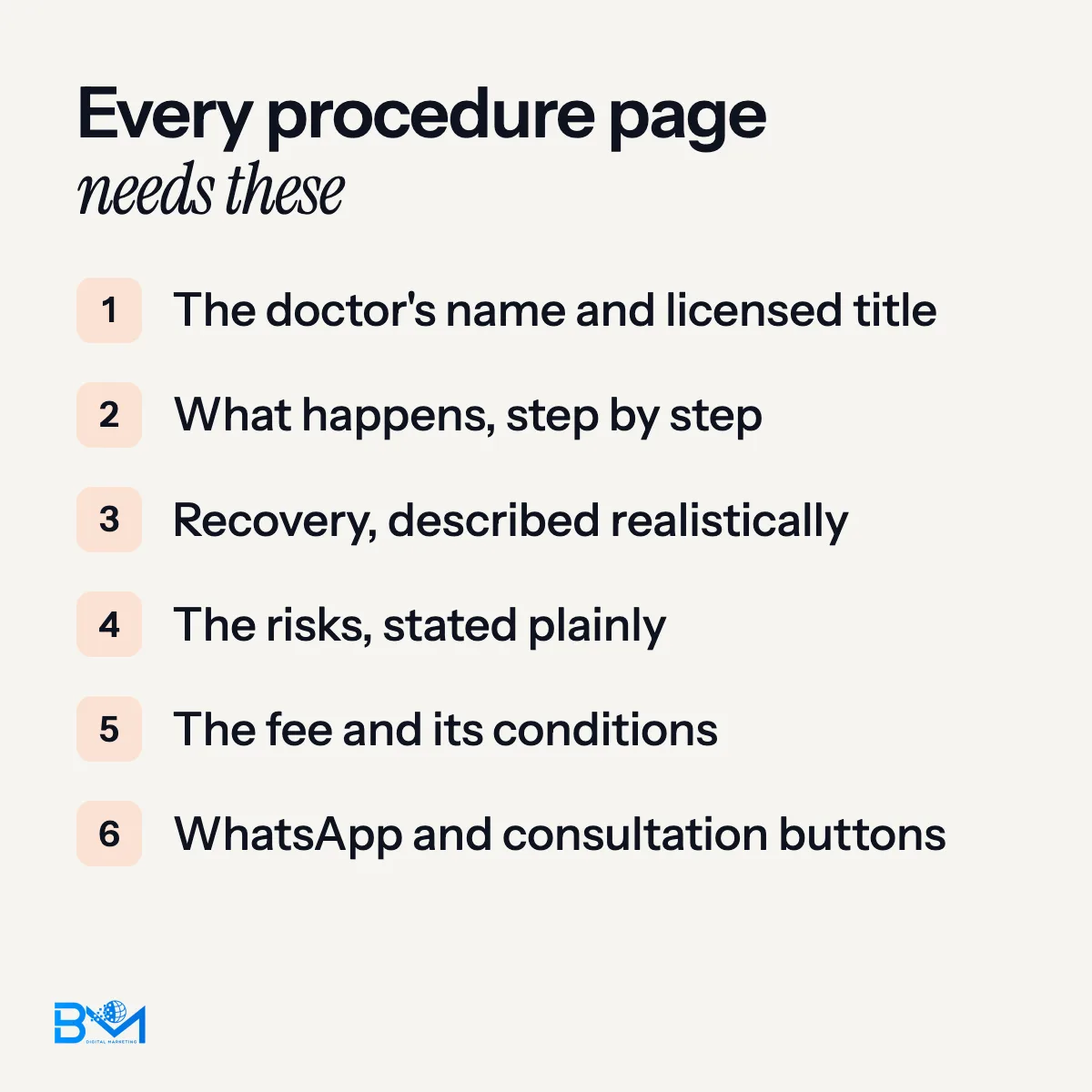
Patients research a rhinoplasty very differently from a laser session, so one “treatments” page can’t serve both. Build one page per treatment, and one per doctor. Each procedure page should cover:
- Who performs it, with their name and exact licensed title.
- What happens, step by step.
- Recovery, described realistically: DHA flags recovery-time claims that may lead to unrealistic expectations.
- The risks, stated plainly.
- The fee, or what shapes it, with its conditions.
- A WhatsApp button and a short consultation form.
Write the Arabic version from scratch rather than translating word for word, and have the doctor approve every medical line before it goes live. Short videos of your doctors explaining a treatment help patients judge their manner and expertise; our guide to video marketing in Dubai covers formats. Every patient who appears needs written consent.
Google Maps and reviews
Each branch needs a complete Google Business Profile. Google counts doctors as individual practitioners, who may have their own profile; where several doctors share a location, the clinic keeps its own profile and each doctor’s profile carries only the doctor’s name. Keep that name and title identical to the DHA licence.
Ask every patient for a review, but never offer anything for it: Google forbids incentives such as payment, discounts or free services in exchange for a review. Reply without discussing anyone’s treatment in public, since DHA asks clinics to avoid social media discussions with patients who may disclose their health information. Our guide to dental clinic marketing in Dubai covers profiles and reviews for clinics step by step.
From first message to booked consultation
Most of this work ends in a message asking about cost, pain and time off work. What happens next decides whether the ad spend becomes patients.
- Reply quickly, with approved wording. Agree standard answers with your doctors in English and Arabic. Promise nothing medical in a chat.
- Keep health details private. Move detailed questions to a private chat or the consultation.
- Offer the consultation. DHA’s non-surgical cosmetic standard makes a face-to-face consultation and assessment mandatory before any non-surgical cosmetic procedure, and does not accept a remote consultation for it.
- Follow up only with permission. WhatsApp’s Business Messaging Policy requires opt-in permission before you message someone, and any request to stop must be respected. DHA also lists giving a patient an unsolicited appointment time they have not requested as not acceptable, so offer slots when the patient asks to book.
- Confirm and remind. Confirm the booking in your clinic system and send a reminder the day before.
How to measure what your marketing brings
Track these per campaign and treatment family every month:
| Measure | What it tells you | Where it comes from |
|---|---|---|
| Enquiries: chats, calls, forms | Whether the ad and the page persuade | Ad platforms and your CRM |
| Reply time | Whether you answer before the next clinic does | WhatsApp and CRM timestamps |
| Consultations booked | The result marketing is accountable for | Your front desk system |
| Consultations attended | Whether confirmations and reminders work | Your front desk system |
| Ad cost per booked consultation | Which treatments deserve more budget | Ad spend divided by consultations booked |
The report needs numbers only. No patient name, photo or note has to leave the clinic.
How we approach aesthetic clinic marketing at BM
At BM we count results as booked meetings, and for a clinic that means booked consultations. Before anything goes live, we check each line of an ad or page against DHA’s standards and match every title to the practitioner’s licence; responsibility for medical claims stays with the licensed clinic. Our CRM, part of our lead-generation package, logs each enquiry with the campaign behind it, replies on WhatsApp and records the consultations each campaign books. We don’t promise a number of patients before a campaign has run.
Frequently asked questions
How do I advertise my aesthetics business in Dubai?
Start with the rules: titles that match each practitioner’s DHA licence, no absolute claims, consented before-and-after photos with DHA’s statement that results vary, and your MOHAP medical advertisement licence number on your official account. Then build a page per treatment, run search ads by treatment and area, keep your Google Maps profile complete, and use Instagram for doctor-led content. Measure booked consultations.
Who can practise aesthetics in Dubai?
DHA-licensed professionals in a DHA-licensed facility. Cosmetic Botox and fillers may only be given by a trained and privileged licensed physician, and a DHA-licensed plastic surgeon or dermatologist supervises non-surgical cosmetic procedures.
Can I advertise Botox on Google or Instagram in the UAE?
Not by name. Google does not allow prescription drug terms in ads or landing pages outside Canada, New Zealand and the United States, and its list includes botox. Meta allows prescription drug ads only from certified advertisers targeting the United States, Canada or New Zealand. Advertise the treatment and the consultation instead.
Are before-and-after photos allowed?
Yes, with conditions. DHA requires the same person, the same lens, no editing, written consent, the risks, and its statement that results vary, in the same font size as the rest of the advert. Meta allows them for general cosmetic procedures in ads aimed at people aged 18 and over.
Can influencers promote my clinic?
Under DHA’s standard, an influencer, doctor or staff member who names your clinic or its location in promotional content needs your Medical Director’s approval of that content. Federal rules on influencer advertising also apply and change, so check the current position before you agree a campaign.
How much should an aesthetic clinic spend on advertising?
It depends on how many treatments and branches you promote, how crowded their searches are, the languages you run, and how many consultations your doctors can take each week. Set the budget per treatment family and judge it by ad cost per booked consultation.
Want it done for you?
BM plans and runs aesthetic clinic marketing in Dubai: wording checked against DHA’s standards, procedure pages, Google and Meta campaigns, and WhatsApp follow-up counted to the booked consultation. See our aesthetic clinic marketing service, or book a meeting with us at our office in Dubai Media City.
Related reading: Dental clinic marketing in Dubai: from ad to booked appointment · Video marketing in Dubai: how videos generate more leads.
Sources
Dubai Health Authority, checked 23 November 2026:
- Standards for Medical Advertisement Content on Social Media (version 1.1)
- Standards for Non-Surgical Cosmetic Procedures (version 2)
Google, checked 23 November 2026:
- Healthcare and medicines: Restricted drug terms
- Prescription drugs list
- Health in personalized advertising
- Personalized advertising
- Guidelines for representing your business on Google (individual practitioners)
- Maps user-contributed content policy (fake engagement)
Meta and WhatsApp, checked 23 November 2026:
How we write. AI tools help with research and outlines. A person writes, edits and checks every article before it goes live.
Written by
Bilal Azam
Digital Marketing Manager, BM Digital Marketing
Shapes each client's marketing plan at BM: which channels to use, what to say to buyers and how the budget is split between them.