DHA Medical Advertising Rules: What Dubai Clinics Can and Cannot Post
DHA advertising guidelines for Dubai clinics: banned words, before-and-after photo rules, medical director sign-off and influencers, from DHA's own text.
On this page
- The short version
- Which DHA document applies, and is it new?
- Words and claims DHA does not allow
- What DHA says you can post
- Before-and-after photos and videos
- Your medical director signs off
- Influencers, doctors’ own accounts and paid partners
- The licence number on your account
- Does this cover Google Ads, your website and WhatsApp?
- How we handle this at BM
- Frequently asked questions
- Want it done for you?
- Sources
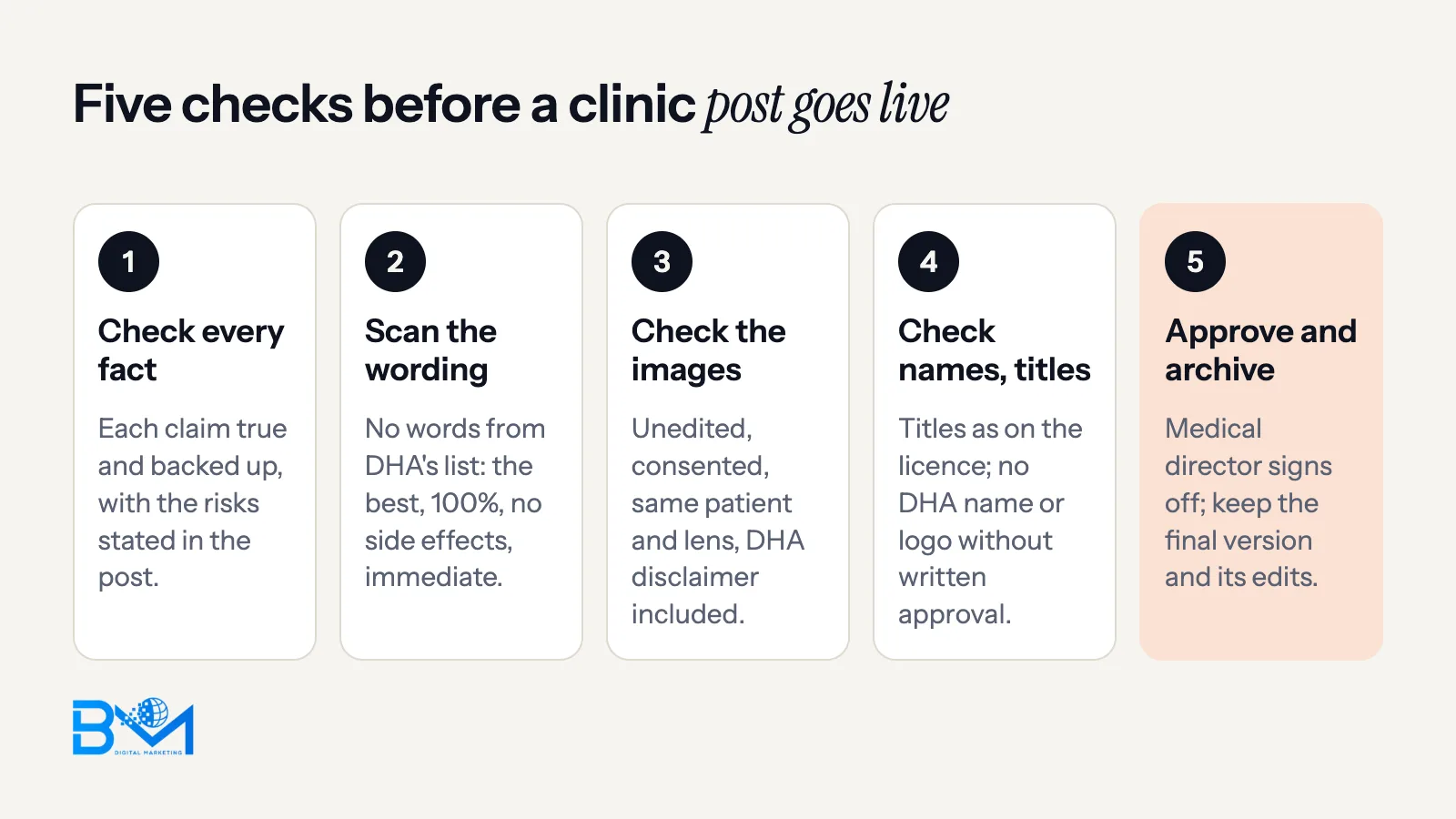
Dubai Health Authority’s rules for clinic posts are set out in its Standards for Medical Advertisement Content on Social Media. Every post must be factual and backed up, must state the risks, and must be approved by your medical director when it uses your facility’s name or location. Words such as “the best”, “100%”, “has no side effects” and “immediate results” are not allowed, and before-and-after photos must be unedited, of the same patient, and carry DHA’s own disclaimer.
DHA sent the standard again to every licensed private health facility and professional in Dubai in a circular dated 17 August 2026, with a warning that failing to comply leads to disciplinary action. This guide explains what the document says in plain words: banned claims, what you can post, photos and videos, sign-off, influencers, and the licence number on your account. Every rule is taken from DHA’s own text, checked in November 2026, with sources listed at the end.
The short version
- The rulebook: DHA’s Standards for Medical Advertisement Content on Social Media, Version 1.1, in force since October 2022 and circulated again on 17 August 2026.
- Banned words: absolute, exaggerated and alarming expressions, including “unique”, “the best”, “safest”, “magic”, “100%”, “has no side effects” and “immediate results”. The list is not exhaustive.
- Sign-off: any post that uses your facility’s name or location needs your medical director’s approval, and the medical director is accountable for it.
- Before and after: same person, same lens, no editing software, DHA’s disclaimer in the same font size, the risks, and written consent.
- Influencers: anyone promoting your facility by name or location needs medical director approval, and the facility is liable for content filmed on its premises.
- Your account: the facility’s official account must show its medical advertisement licence number from the Ministry of Health and Prevention (MOHAP).
Which DHA document applies, and is it new?
The document is DHA’s Standards for Medical Advertisement Content on Social Media, code DHA/HRS/HPSD/ST-21, Version 1.1. It was issued on 3 August 2022, took effect on 3 October 2022, and is due for revision on 3 August 2027.
DHA’s circular CIR-2026-00000144, dated 17 August 2026, is addressed to all licensed health facilities and healthcare professionals in Dubai’s private sector. It calls the standard new, but the file it links to is the same Version 1.1 document. So the rules haven’t changed. What has changed is that every private facility has been reminded of them in writing, and the circular says failure to comply will result in “suitable disciplinary actions”.
Who and what it covers
The standard applies to all DHA-licensed health facilities and healthcare professionals who advertise on social media. DHA defines a social media advertisement very widely: any information about a health product, service, facility, professional, treatment or therapy published on social media. That covers your organic posts, stories and reels as well as paid ads.
DHA’s list of social media includes Facebook, Instagram, WhatsApp, YouTube, Snapchat and LinkedIn, and it says “not limited to”. Don’t assume a platform that isn’t named, such as TikTok, is outside the rules.
Words and claims DHA does not allow
Clause 6.11 is the one to know by heart. It bans absolute statements, exaggerated claims and alarming expressions, and gives this list, “such as, but not limited to”:
unique, one of a kind, the best, exclusive, safest, the only, incomparable, unprecedented, best product, magic, miraculous, assured success, very limited quantity, has no side effects, get money back, 100%, absolutely certain, distinguished, famous, pioneer and immediate results.
The list is open-ended, so close cousins such as “number one” or “zero risk” carry the same problem. Beyond single words, the standard and its appendices rule out:
- Superiority and comparisons. Claiming your services are better than another doctor’s or facility’s, and comparing treatments unless the comparison is scientifically proven and supported by credible references.
- Attacks on others. Negative statements about another healthcare professional, health facility or government entity.
- Fear. Making patients afraid or concerned about their health to increase demand, or creating an unnecessary need for a procedure.
- Unrealistic expectations. DHA names phrases such as “don’t delay”, “achieve the look you want” and “looking better and feeling more confident”, and warns against recovery-time claims that may lead to unrealistic expectations.
- Cure promises. Treatments that guarantee full recovery, and any suggestion that a treatment is infallible, magical or a certain cure.
- Misleading prices. Inaccurate prices, prices without their conditions, and time-limited discounts or inducements that can’t be met.
- Wrong titles. Any title that differs from the DHA licence, such as “Aesthetic Specialist”, “Cosmetologist” or “Anti-Aging Specialist”. “Dr.” is only for physicians, dentists and healthcare professionals holding a recognised PhD.
- Government names and logos. Using DHA’s or any other authority’s name or logo in social media content without explicit written approval. That includes lines like “approved by DHA”.
How to rewrite common lines
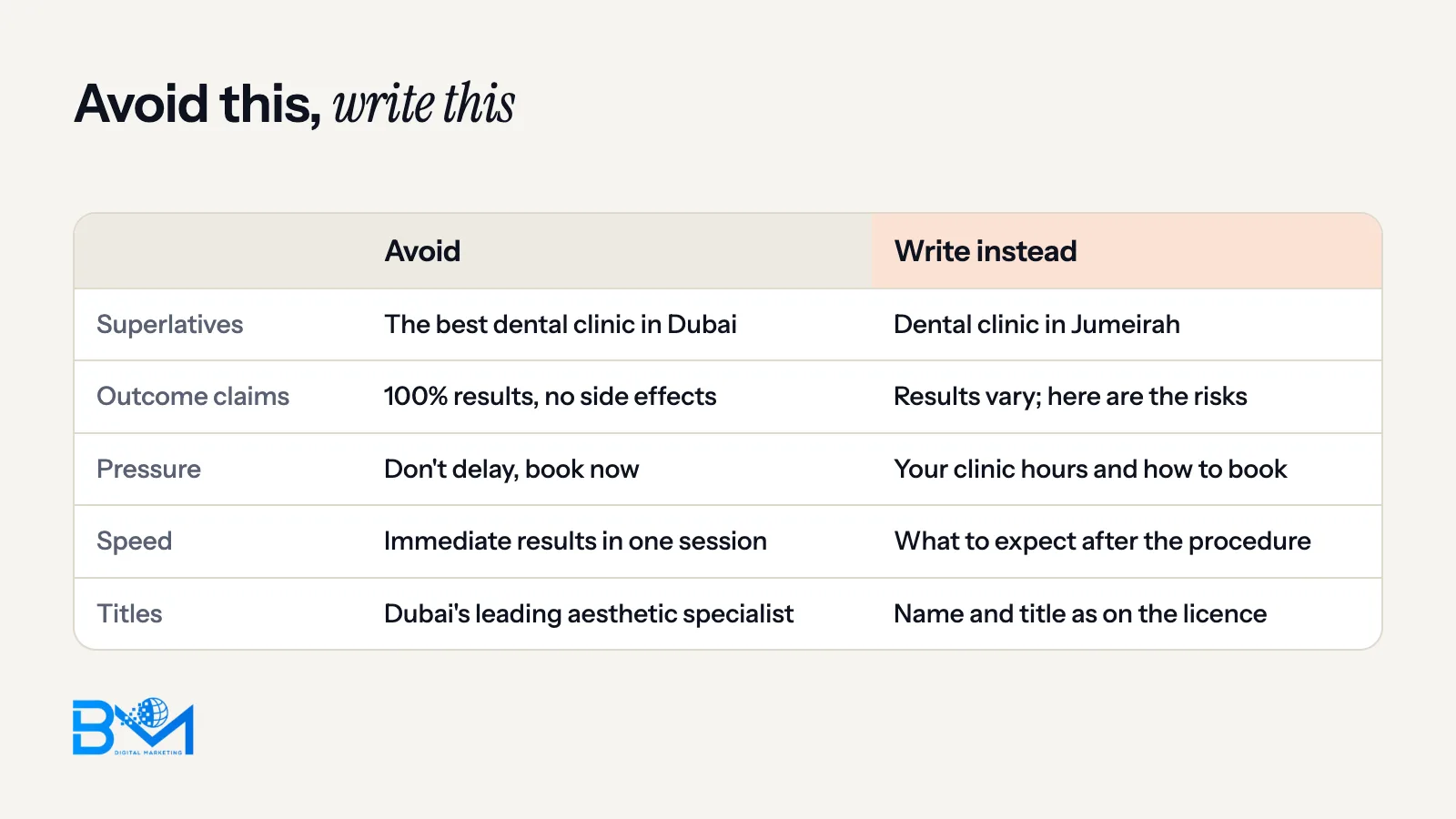
Most banned lines have a factual version. These rewrites follow the standard’s list of what is acceptable:
| Avoid | Why | Write instead |
|---|---|---|
| “The best dental clinic in Dubai” | “The best” is on DHA’s list | “Dental clinic in Jumeirah”, with your hours and contact details |
| “100% results, no side effects” | Both phrases are banned, and the risks must be stated | “Results vary from person to person”, followed by the risks your doctor lists |
| “Don’t delay, book now” | DHA gives it as an example of encouraging unnecessary use of health services | Your clinic hours and how to book |
| “Immediate results in one session” | “Immediate results” is on the list | What the procedure involves and what to expect afterwards, explained by the doctor |
| “Dubai’s leading aesthetic specialist” | Superiority claim, and a title that isn’t on the licence | The doctor’s name, title and specialty exactly as on the licence |
What DHA says you can post
The standard’s Appendix 1 lists what is acceptable, and it gives you plenty to work with:
- A factual, clear statement of the services and products you offer.
- Contact details: your address, email, website and phone numbers.
- The gender of your healthcare professionals, and languages other than English they speak fluently.
- Your regular hours and whether you offer after-hours services.
- For surgical and invasive procedures, the appropriate warning statement in a clearly visible position.
- Non-enhanced photos or drawings of the doctor or the clinic.
- Fees, insurance arrangements and instalment plans you regularly accept.
- Qualifications, the schools and training programmes the doctor graduated from, titles recognised by DHA, teaching positions, accreditations and peer-reviewed publications.
- Public health information that encourages preventive or corrective care, evidence-based wherever possible.
Educational posts fit these rules well: explain a procedure, who it suits, the risks and the recovery. DHA also asks professionals to say whether information is based on scientific studies, expert consensus, professional experience or personal opinion.
The standard also asks that content and language be professional and culturally sensitive, and that images respect UAE culture and Islamic teachings, avoid intimacy or sex appeal, and don’t use UAE sovereignty symbols without approval. Bilingual clinics should apply this to the Arabic and English versions alike.
Before-and-after photos and videos
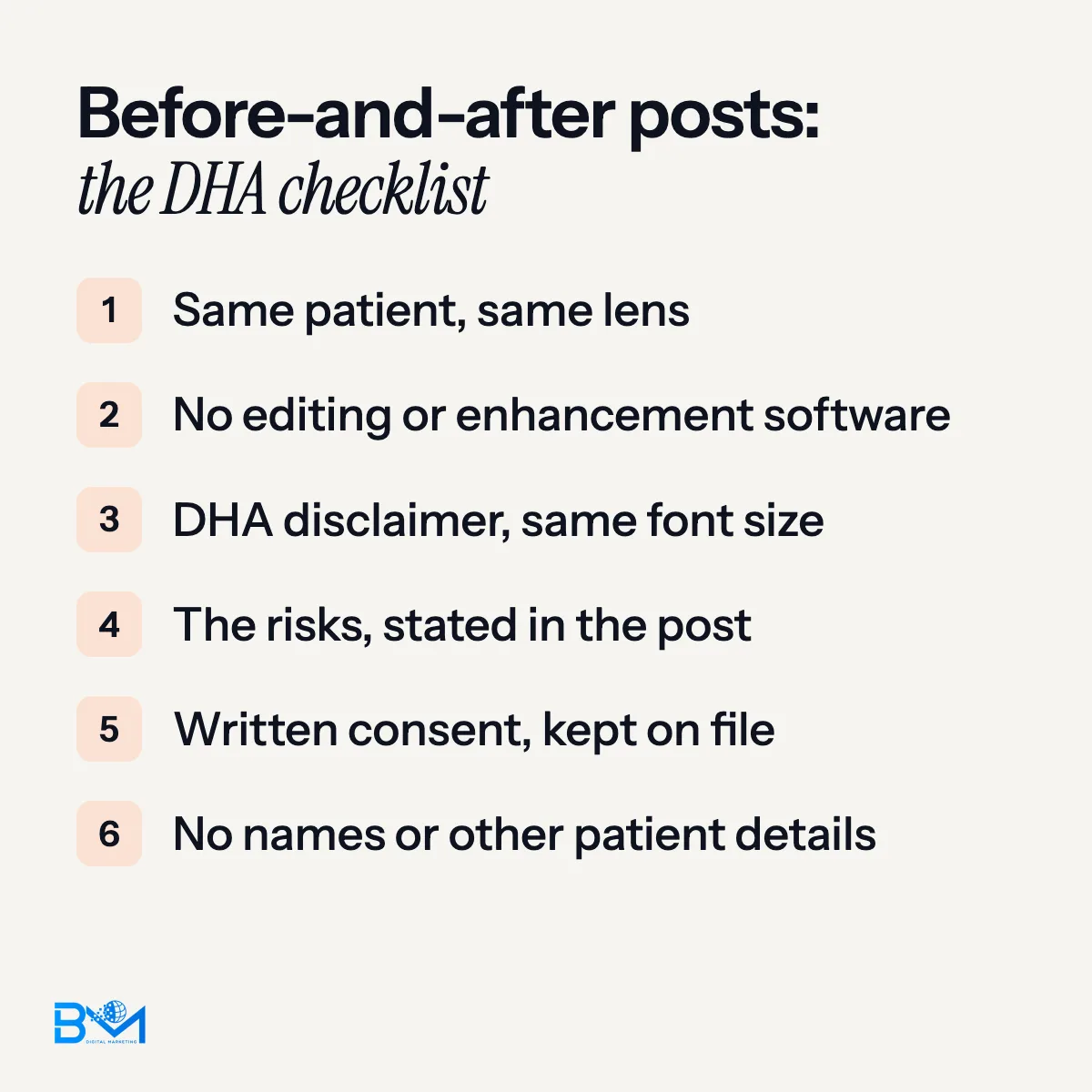
Before-and-after content is allowed, with conditions. Clause 9.6 says the photos must be of the same individual, taken with the same lens, with no Photoshop enhancements or equivalent software. Each one must carry this statement, written in the same font size as the rest of the post:
“there is no guarantee that the result will be the same, as it might vary from one individual to another”
The post must also state the risks. On top of that:
- Written consent: obtain and document it from anyone whose pictures, images, videos or statements you use. Consent covers only the subject and period it was given for.
- Real patients only: the images must show patients who actually received the treatment.
- No identifying details: patient-identifiable information is on DHA’s prohibited list, and professionals must avoid identifying patients.
- Children: for a patient under 18, get verifiable consent from a parent before using their information.
- No filming in theatre: no filming or live streaming for promotion while a patient is undergoing surgery, under general anaesthesia, or in procedure rooms.
- Fine print: any fine print must sit in a prominent place and be legible to the unaided eye.
Your medical director signs off
DHA puts the medical director at the centre. Anyone who promotes a service or result using the facility’s name or location, whether a doctor, an influencer or a member of the admin team, must make sure the medical director approves the content. The medical director must tell all staff about this rule and is accountable for the content and style of posts on any account that promotes the facility.
The standard also tells the medical director to:
- Nominate trained, experienced people to moderate the facility’s social media accounts.
- Train all staff on social media use at induction, with refreshers at regular intervals, and keep a written social media policy.
- Archive posts with their edits and formats for verification and audit. DHA’s Health Regulation Sector may audit them.
- Make sure every healthcare professional keeps separate personal and professional accounts, and avoids interacting with current or past patients on personal accounts.
- Put access controls in place so nobody unauthorised can post from the facility’s accounts.
In practice, keep a simple log: the draft, who approved it and when, and the final version as published. If an agency runs your accounts, the agency drafts and the medical director approves.
Influencers, doctors’ own accounts and paid partners
- Influencers need approval. An influencer who promotes your facility by name or location falls under the same medical director approval rule.
- Your premises, your liability. The facility is liable for all content filmed on its premises, professionally or on a phone, including content by influencers on their personal accounts.
- Disclose payment. Facilities and professionals paid, or given other material benefit, to promote products or services should document the relationship and disclose it to patients.
- Doctors’ own pages. A professional who promotes only their own service, without the facility’s name or location, is responsible for that content. Visiting doctors who also practise abroad need a separate account for Dubai, and patients treated in Dubai must not appear on international accounts.
There is a federal layer too. The National Media Authority issues a permit that allows individuals to publish advertising content on their social media accounts, whether paid or unpaid, and it requires that content to comply with media content standards. If you hire a content creator, check that they hold one before you book them.
The licence number on your account
Clause 5.2 says the facility’s official account must state its medical advertisement licence number provided by MOHAP. Put it in the bio of every official account.
MOHAP’s health advertisement licensing service lists general clinics, polyclinics, specialty clinics, hospitals and pharmacies among the businesses it serves. To register a facility, it asks for a valid medical licence, a valid trade licence, and the Emirates ID of the person responsible for health advertising. It gives three working days as the completion time. Adverts in languages other than Arabic or English must be legally translated into one of them. MOHAP also states that its licence doesn’t exempt you from requirements imposed by other parties, so DHA’s content rules still apply. Service pages change, so check the current process with MOHAP before you apply.
Does this cover Google Ads, your website and WhatsApp?
The standard is written for social media, and its examples go wide. It names WhatsApp in its definition of social media, and its background section lists Google and WhatsApp under social networking.
WhatsApp deserves care. Appendix 1 lists, as not acceptable, giving a patient an unsolicited appointment time they haven’t asked for. Offer times when a patient asks to book, not in a cold message.
For Google Ads and landing pages, the simplest approach is to hold them to the same wording rules, because the same patient reads your ad, your page and your Instagram. Our guide to PPC advertising for local businesses in Dubai covers how search ads work.
How we handle this at BM
At BM we run Google Ads and landing pages for a Dubai hair transplant clinic. Patients search for phrases like “best hair transplant Dubai”, so the searches contain words the ads can’t repeat. We can bid on those searches, but no headline, description or page we write says “best”, “guaranteed” or “no side effects”. Our headlines describe the procedure, the surgeon and how to book a consultation, and any line about results sits next to the risks. Under DHA’s standard, approval belongs to the clinic’s medical director, not to us, so we treat our text as a draft for the clinic’s medical team to approve. For Facebook and Instagram campaigns, our guide to Meta ads for Dubai businesses covers the setup side.
Frequently asked questions
What are the advertising regulations in the UAE?
There are several layers. The National Media Authority publishes the UAE’s media content standards, which cover advertising, and issues a permit that allows individuals to publish advertising content on social media. MOHAP licenses health advertisements, and DHA’s standard requires a facility’s official account to show its MOHAP licence number. In Dubai, the DHA standard governs medical content on social media for DHA-licensed facilities and professionals. Rules change, so check the current versions before you advertise.
Can a Dubai clinic post before-and-after photos?
Yes, if they show the same patient, taken with the same lens, with no editing software. Each post needs DHA’s disclaimer in the same font size as the rest of the text, the risks, and documented written consent from the patient.
Can we use “best” if patients search for it?
Not in your post, ad or page. “The best” and “best product” are both on DHA’s list. Describe the service, the doctor and the clinic factually instead.
Do influencers need approval to promote our clinic?
Yes. If they name your facility or its location, your medical director must approve the content. Separately, the National Media Authority’s permit covers individuals who publish advertising content on social media.
What happens if a clinic breaks the rules?
DHA’s August 2026 circular says failure to comply will result in suitable disciplinary action. The standard also says DHA’s Health Regulation Sector may audit social media posts, and medical directors must tell staff about the potential penalties for violations.
Can we post prices and offers?
Fees, insurance arrangements and instalment plans are on DHA’s acceptable list. Prices must be accurate and state their conditions, and a time-limited discount you can’t honour is not acceptable.
Do the rules apply to doctors’ personal accounts?
Doctors must keep separate personal and professional accounts, and they are accountable for posts on their personal accounts. Any account that promotes the facility, personal or not, falls under the medical director’s responsibility.
Want it done for you?
BM plans and runs ads, landing pages and social content for clinics in Dubai, written to DHA’s wording rules and checked against the standard before your medical director signs off. See our healthcare marketing service, or book a meeting with us at our office.
Related reading: What a digital marketing agency in Business Bay does for your brand · The benefits of PPC advertising for local businesses in Dubai.
Sources
Dubai Health Authority, checked 23 November 2026:
- Standards for Medical Advertisement Content on Social Media, Version 1.1 (PDF)
- Circular CIR-2026-00000144: Standards for Medical Advertisement Content on Social Media (17 August 2026)
Ministry of Health and Prevention, checked 23 November 2026:
National Media Authority, checked 23 November 2026:
How we write. AI tools help with research and outlines. A person writes, edits and checks every article before it goes live.
Written by
Bilal Azam
Digital Marketing Manager, BM Digital Marketing
Shapes each client's marketing plan at BM: which channels to use, what to say to buyers and how the budget is split between them.