Interior Design and Fit-Out Marketing in Dubai: Get Project Enquiries
Interior design marketing in Dubai: how fit-out firms get project enquiries from Google Ads, Google Maps, Instagram and project pages, then book visits.

On this page
- The short version
- Know who you’re marketing to
- Build project pages before you spend on ads
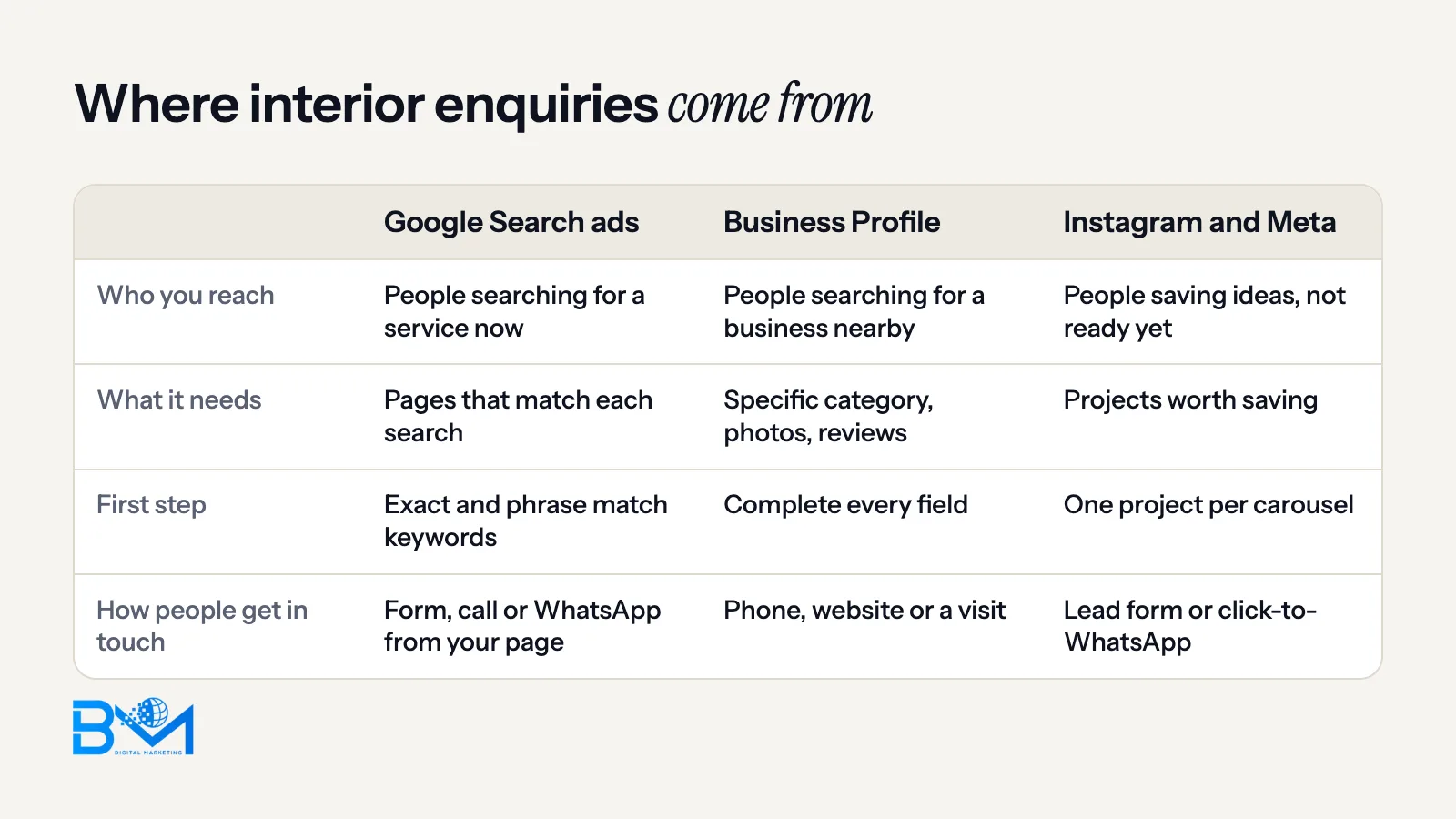
- Google Search ads: reach people with a project in mind
- Google Business Profile: the map results
- Instagram and Meta ads: stay in view while they plan
- Reply fast, and qualify before the site visit
- Measure booked consultations, not clicks
- What we learned running Google Ads for Artline Interiors
- Frequently asked questions
- Want it done for you?
- Sources
Interior design and fit-out companies in Dubai get project enquiries by being found by people who already have a property and a deadline, then proving they have done that kind of space before. In practice that means Google Search ads and a Google Business Profile for people searching now, project pages that show your work, Instagram and Meta ads for people still collecting ideas, and a fast, specific reply that books a consultation or a site visit.
This guide takes each channel in the order most studios should build it, lists the questions to ask every enquiry, and shows how to measure the booked consultations that become projects. Platform features come from Google’s and Meta’s own help pages, checked on 23 November 2026. The examples come from our own work for a Dubai interior design and fit-out company.
The short version
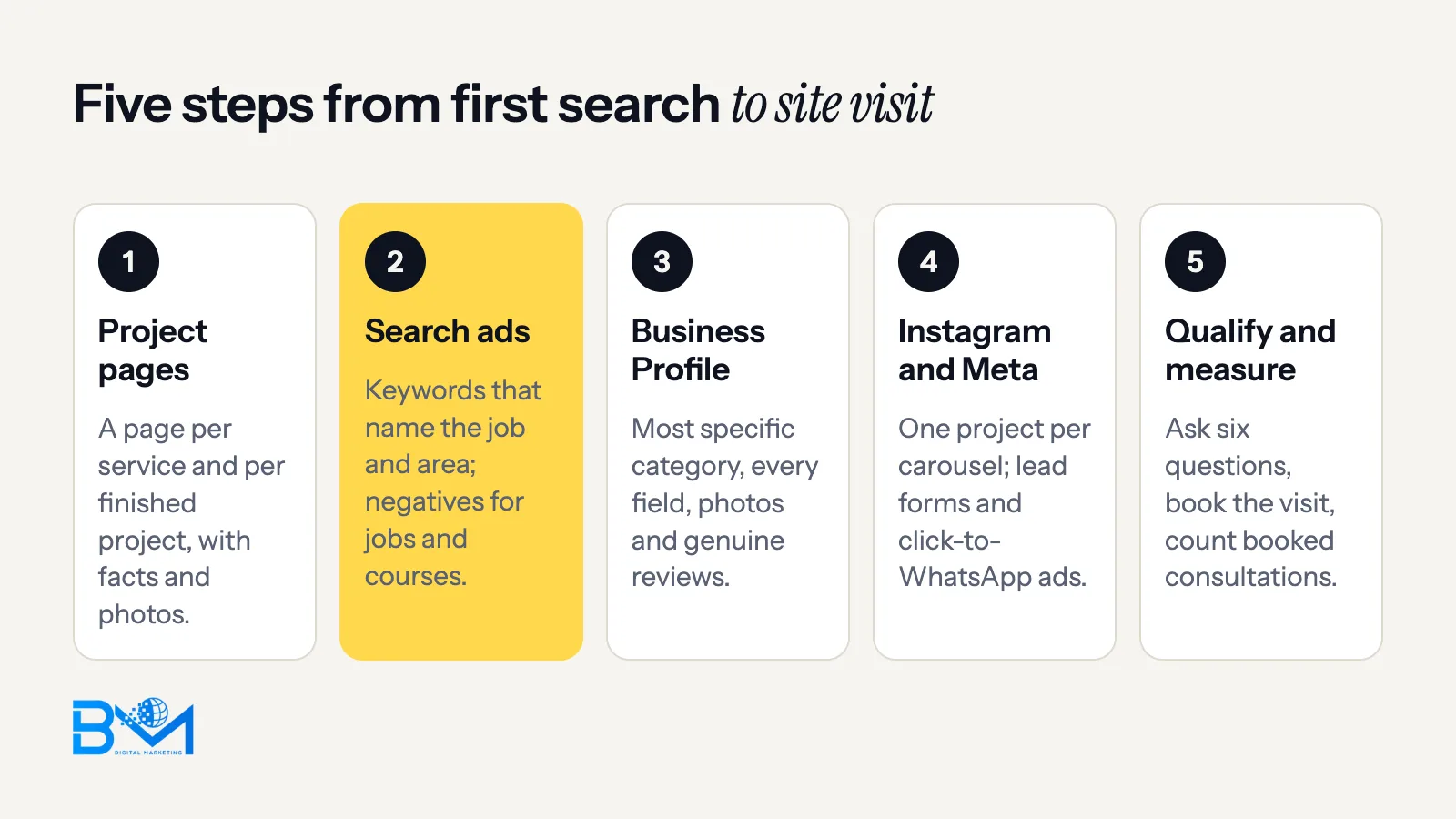
- Pages first: build a page for each service and each finished project before you spend on ads. Ads only work as well as the page they open.
- Search ads for people with a job in mind: keywords that name the service and the area, and negative keywords to keep out job seekers, students and idea-browsers.
- Google Maps matters: a complete Business Profile with the most specific category, real project photos and genuine reviews.
- Instagram keeps you in view while people collect ideas. Lead forms and click-to-WhatsApp ads turn that interest into enquiries.
- Qualify before you visit: property type, size, scope, budget range and timing, asked in the form or in the first WhatsApp reply.
- Count booked consultations, not clicks or leads, and judge every channel by the cost of each one.
Know who you’re marketing to
“Interior design” is typed by a family collecting villa keys, a clinic about to open and a developer furnishing a show apartment. Each needs different pages, photos and questions:
| Buyer | What starts the project | What they search for | What convinces them |
|---|---|---|---|
| Villa and apartment owners | A handover, a renovation or a move | The style, the room and the community | Finished homes like theirs, and a clear process |
| Offices and clinics | A lease start or an opening date | Fit-out by type of space and area | Past work in the same type of space, and a programme they can plan around |
| Shops, restaurants and cafés | An opening date | Retail or restaurant fit-out contractors | Projects delivered on time, with photos of the finished space |
| Developers and landlords | Show units, lobbies, furnished packages | Fit-out contractors and furnishing packages | A company profile, a project list and references |
Pick the one or two buyers you most want, and build your marketing around them first. A studio that tries to speak to all four at once usually ends up with pages and ads that convince none of them.
Build project pages before you spend on ads
Buyers decide on photos before they read a word, but a gallery alone doesn’t answer their questions. Give each finished project its own page with the facts a buyer would ask in your studio:
- The facts: property type, community or building, size, the rooms in scope, and how long the work took.
- The brief and the result: what the client wanted, what you changed, and the materials used.
- Photos with context: before and after where you have them, wide shots and close-ups of joinery, stone and lighting.
- A way to start: a WhatsApp button and a short form on every page, not only on the contact page.
Then give each service its own page: villa interiors, office fit-out, retail fit-out, restaurant fit-out. That gives every ad a page that matches the search, and gives Google more to rank for. Write Arabic pages for the services Arabic-speaking clients buy, written by an Arabic speaker rather than translated word for word. Our guides to website design best practices for Dubai companies and what a website costs in Dubai cover the build itself.
When we designed Artline Interiors’ new website, we gave it a portfolio sorted by category and clearly defined sections for residential, office, retail and restaurant fit-out services. The Artline Interiors website case study reports a mobile performance score of 92 in Google PageSpeed Insights, and more contact and WhatsApp enquiries within the first month of launch.
Google Search ads: reach people with a project in mind
Someone searching “office fit-out Business Bay” has a space and a date. Search ads put you in front of them at that moment, so they usually deserve the first share of your budget.
Keywords that name the job
Group campaigns by service, property type and area: villa interiors in Dubai Hills, office fit-out in Business Bay, restaurant fit-out in Jumeirah. Send each group to the matching service or project page. Use exact and phrase match for most keywords. Google says exact match shows your ad on searches with the same meaning or intent as the keyword, and phrase match on searches that include its meaning. Both reach fewer searches than broad match, which keeps spend closer to the job you named.
Negative keywords
Negative keywords let you exclude search terms from your campaigns. Interior design attracts a lot of searches that will never become a project. Add negatives such as:
- Jobs and study: jobs, vacancy, salary, internship, course, diploma.
- Do-it-yourself and inspiration: DIY, ideas, pictures, wallpaper, software.
- Services you don’t offer, such as furniture rental or cleaning.
Check which searches triggered your ads every week in the first months, and add new negatives as they appear.
Location settings
Google offers two broad choices. “Presence or Interest” can reach people in your target area and people who have shown an interest in it. Google suggests “Presence” when you only want to reach people in specific locations. If you want owners who live abroad and furnish a Dubai home from overseas, the broader setting can include them; an office fit-out campaign for local businesses may suit “Presence”. Decide campaign by campaign.
Ad assets that show the work
| Asset | What Google says it does | How a studio can use it |
|---|---|---|
| Image assets | Adds visuals to complement your text ads | A finished room or a before-and-after from the project page |
| Call assets | Adds your phone number to your ads | For office and shop owners who prefer to call |
| Location assets | Can show your address, a map or the distance to you | For showrooms and studios that receive visitors |
| Lead form assets | Lets people submit their details in a form inside the ad | A short form with your qualifying questions; you must link a privacy policy |
Google Business Profile: the map results
When someone searches for a business near them, Google shows local results on Google Maps and Search. Google says those results are mainly based on relevance, distance and popularity, and that businesses with complete and accurate information are more likely to show up. To make the most of it:
- Category: choose the most specific primary category that describes your core work. Google’s own example is choosing “Nail salon” rather than “Salon”.
- Every field: services, hours, website and phone, all matching your website.
- Photos after every handover, plus your team and showroom.
- Reviews: ask every client once they have moved in, using Google’s review link or QR code, and reply to every review. Reviews must reflect a genuine experience, and Google prohibits offering free or discounted goods or services in exchange for them.
Instagram and Meta ads: stay in view while they plan
Homeowners who aren’t ready to hire yet still save photos and follow studios. Content worth saving keeps your name in front of them until they are:
- One project per carousel. Instagram lets you share up to 20 photos and videos in a single post: living room, kitchen, majlis, bedroom, slide by slide, with the materials named.
- Walk-through videos of finished spaces, filmed vertically, with the community and scope on screen.
- Before and after of the same corner. Few posts explain what a designer does as quickly.
- Details up close: joinery, stone, fabric, lighting. Buyers who care about finish save these.
Paid Meta ads turn that interest into enquiries. Two formats suit interior work. Lead forms (Instant Forms) can include your own questions, with a drop-down of answers, so budget and timing can be asked as bands. Meta’s higher intent setting adds a step where people review and confirm their answers before they submit. Click-to-WhatsApp ads open a chat instead. If you reply within WhatsApp’s customer service window, Meta doesn’t charge for the WhatsApp messages you send while the free entry point window is open. Our guide on how social media marketing brings in customers covers the organic side in more depth.
Reply fast, and qualify before the site visit
Every site visit takes a designer’s time. Ask the right questions first, in the form or in your first WhatsApp reply, so the visits you book are worth making.
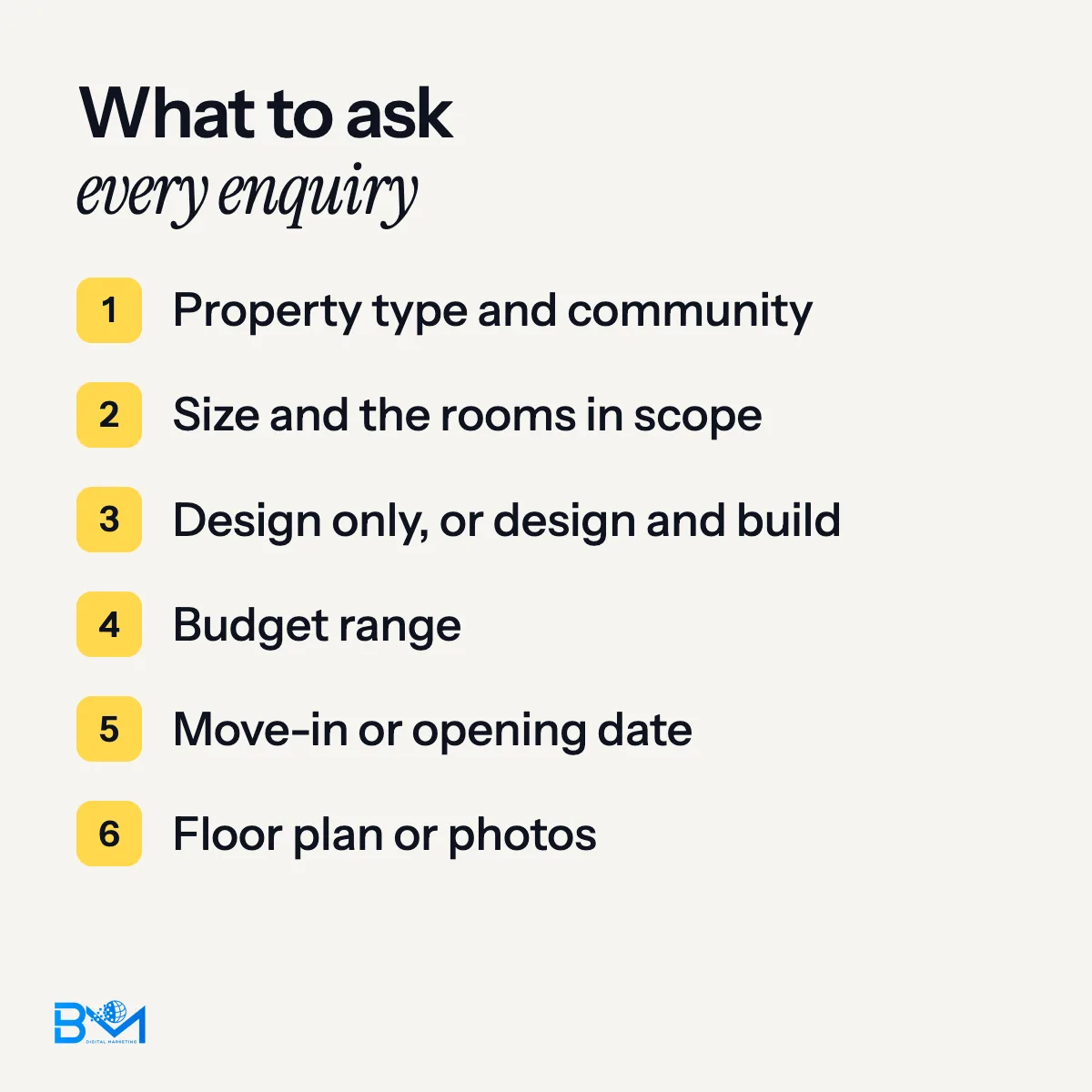
- Property type and community, so you know the scale and can show a similar project.
- Size and the rooms in scope: one bedroom or the whole villa.
- Design only, or design and build.
- Budget range, offered as bands rather than an open box.
- Move-in or opening date.
- A floor plan or photos, sent on WhatsApp.
Reply within minutes where you can, including evenings and weekends. If you plan to follow up on WhatsApp, say so on the form: Meta requires opt-in that clearly states the person is agreeing to hear from your business, and names it. Outside 24 hours from the customer’s last message, the WhatsApp Business Platform only lets you send an approved template, so keep a short follow-up template ready. When the answers fit, book the consultation or site visit straight into a designer’s calendar and confirm it the day before.
Measure booked consultations, not clicks
Clicks and leads are easy to count and easy to inflate. What pays for a studio is booked consultations and site visits that become signed projects. To measure them:
- Track every enquiry: form submissions, WhatsApp clicks and calls, each tagged with the ad or page it came from.
- Move each lead through stages in a CRM: new, qualified, consultation booked, proposal sent, won or lost.
- Send results back to Google. By importing offline conversions, you can measure what happens after your ad results in a click or call. If you haven’t set up offline conversion import yet, Google recommends starting with enhanced conversions for leads, its upgraded version.
- Review monthly the cost per booked consultation for each channel, and move budget towards the cheapest real projects, not the cheapest clicks.
Our article on how digital marketing helps Dubai businesses get more customers covers measurement across other industries.
What we learned running Google Ads for Artline Interiors
At BM we have run Google Ads for Artline Interiors, an interior design and fit-out company in Dubai, as well as building its website. As our Artline Interiors Google Ads case study sets out, the campaign targeted transactional searches such as “villa interior design Dubai” and “office fit-out contractors”, sent people to a fast, mobile-friendly website with WhatsApp and form tracking, and has been kept in shape with negative keywords, bid adjustments, ad testing and segmentation by area. The case study reports over 100 qualified leads every month, from forms and WhatsApp combined, including high-end residential enquiries and corporate fit-out projects. That is one company in one market, and your results will depend on your offer, your area and how fast your team follows up. The approach carries over: match the search, show the work, track the enquiry.
Frequently asked questions
How do interior design companies get clients in Dubai?
By being easy to find for people who are already planning a project: in Google searches that name a service and an area, in the Google Maps results, and on Instagram, where homeowners save ideas. Project pages that prove you’ve done similar work, and a fast reply, turn that interest into consultations.
Are Google Ads worth it for an interior design company?
They can be, because they reach people at the moment they search for a service. Use exact and phrase match keywords, a strong negative keyword list and pages that match each search, then judge the campaign by the cost of each booked consultation rather than the cost of a click.
Should I focus on Instagram or Google?
Most studios need both, for different moments. Google reaches people ready to hire; Instagram keeps you in view while they plan. If budget is tight, start with Search ads and your Google Business Profile, and post finished projects on Instagram consistently.
What should an interior design enquiry form ask?
Property type and community, size and the rooms in scope, design only or design and build, a budget range, the move-in or opening date, and a request for a floor plan or photos. Keep it short and ask the rest on WhatsApp.
How much should an interior design company spend on marketing?
It depends on your average project value, how many projects your team can take on, and what each booked consultation costs in your area and service. Start with a budget you can sustain for several months, measure the cost per booked consultation, and grow the channels that bring real projects.
Do I need Arabic pages and ads?
If you want Arabic-speaking clients, yes. Write Arabic pages and ads for the services they buy, using the words they actually search with, rather than translating your English pages word for word.
Want it done for you?
BM runs Google Ads, Google Business Profiles, Instagram and portfolio websites for interior designers and fit-out companies in Dubai, and counts the consultations and site visits booked. See our interior design marketing service in Dubai, or book a meeting with us at our office in Dubai Media City.
Related reading: Artline Interiors website case study · Website design best practices for Dubai companies.
Sources
Google Ads Help, checked 23 November 2026:
- About keyword matching options
- About negative keywords
- Target ads to geographic locations
- About image assets for search campaigns, call assets, location assets and lead form assets
- About offline conversion imports
Google Business Profile Help, checked 23 November 2026:
Meta and Instagram, checked 23 November 2026:
How we write. AI tools help with research and outlines. A person writes, edits and checks every article before it goes live.
Written by
Bilal Azam
Digital Marketing Manager, BM Digital Marketing
Shapes each client's marketing plan at BM: which channels to use, what to say to buyers and how the budget is split between them.